Why the next era of workforce development will require digital and data infrastructure to scale.
Our Workforce Systems Are Not Systems
Structural and policy conditions in the U.S. promote fragmentation in workforce development, with limited accountability for outcomes across the full learner-to-employment journey. The result is a landscape of individual programs doing important work, but without the connection and coordination needed to turn individual successes into impact at scale.
Across workforce development, the same four challenges surface again and again: Connection, Coordination, Curation, and Credibility.
Together, these challenges perpetuate fragmentation and stand in the way of transforming individual programs into workforce systems that can align talent supply with employer demand at scale.
- Connection: Workforce development is inherently a collective process. Training providers, employers, partners, and system leaders must work together to achieve not just training completion, but placement and retention. Without easy, secure ways to connect, information remains siloed and no one can see the full journey from intake to employment.
- Coordination: Collaboration across workforce partners and engagement with learners are often inefficient, relying on manual processes and relationship-dependent handoffs. These dependencies make coordination costly to scale and create friction for learners and partners alike. Technology and automation can streamline routine tasks, inform next-best actions, and reduce friction, freeing people to focus on higher-value work that improves learner and employer outcomes at scale.
- Curation: Not every learner needs the same journey or the same level of support. Yet workforce systems aren't built to personalize communications, recommend relevant opportunities, or triage learners into different pathways and levels of human support based on their individual needs and goals. Workforce systems need the ability to personalize at scale, serving entire populations without treating every learner or employer the same.
- Credibility: Without the ability to track and aggregate what is working end to end, workforce leaders are left describing impact instead of documenting it. Funders and system leaders increasingly need evidence of distal outcomes, not simply processes and outputs, to understand what really works and where investment creates impact at scale.
These challenges create the friction felt across workforce systems: learners struggling to navigate disconnected programs, employers struggling to find qualified talent, and funders and system leaders struggling to see what is working.
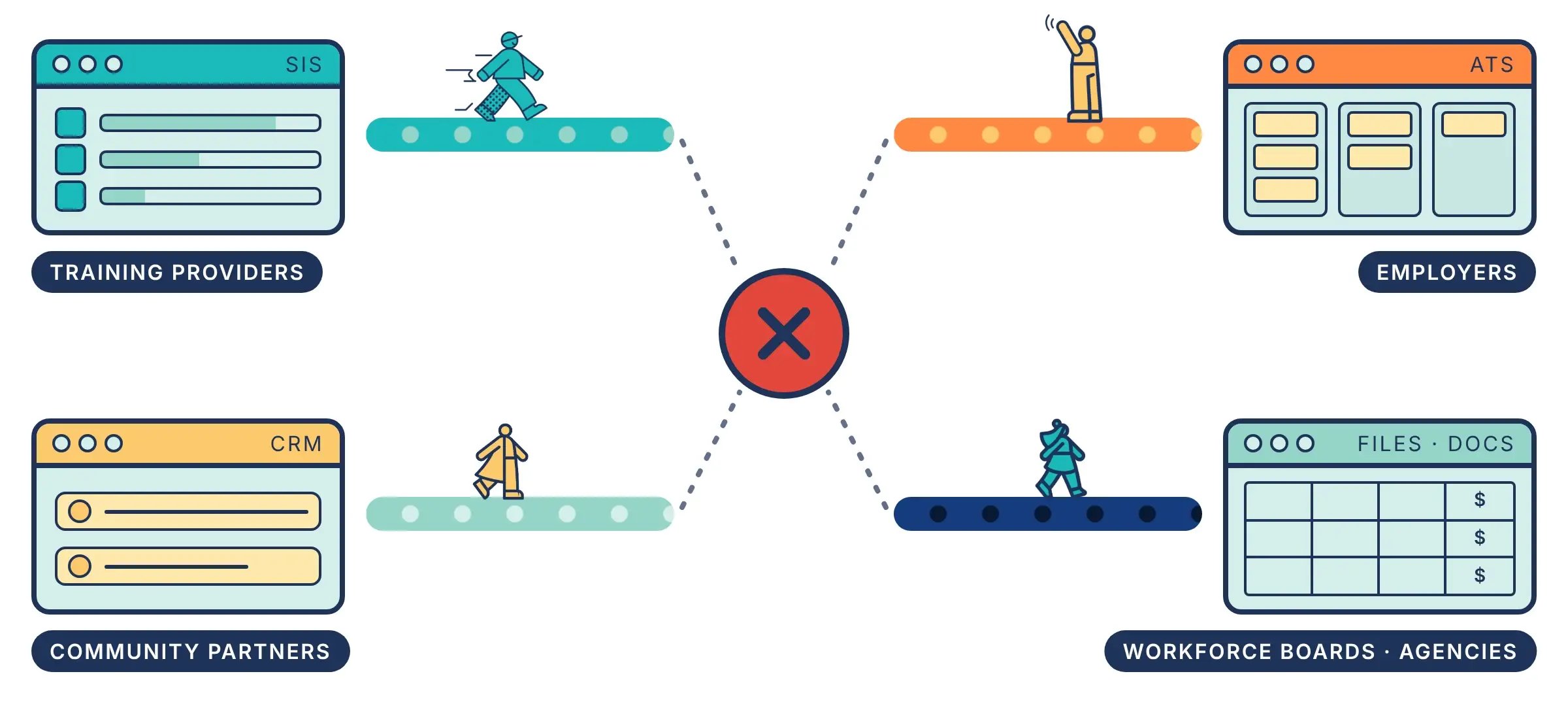
Until now, there hasn't been enough pressure to fundamentally change how workforce development operates.
It's Not OK Anymore
For a long time, these conditions were allowed to persist. Employers found enough talent. Institutions of higher learning had enough students. People found jobs that paid enough to create a life of social mobility. Workforce development got by. There simply wasn't enough pressure to demand a system centered on shared accountability.
That is no longer the case.
Talent shortages are emerging across a growing number of critical sectors, while demographic shifts and declining birth rates are slowing labor force growth. At the same time, traditional pathways to economic mobility are becoming less predictable. A four-year degree can still create significant economic value, but it doesn't guarantee the same return for every learner, while alternative pathways to family-sustaining careers remain difficult to see and navigate.
AI is adding another layer of urgency, rapidly changing skills, workflows, and opportunities and creating a need for reskilling and upskilling at a pace workforce systems were not designed to support. As AI continues to reshape work, it will demand proactive preparedness in the years ahead.
Programs operating in isolation do not solve challenges that require coordination at scale. Workforce systems now need to be connected and coordinated to align talent with demand, curated to respond to different needs, and credible to demonstrate what is working, determine where investment is needed, and fund what delivers results.
The Approach Must Change and Change Now
That leaves workforce development at an inflection point.
Momentum is building. Private funders are recognizing the urgency to change. At the federal level, the current administration and the Departments of Labor and Education are taking steps to better align education and workforce programs and give states greater flexibility to support workforce innovation.
But policy and funding alone cannot create the systems change required. Without addressing the underlying fragmentation, we risk putting new investment through old systems and getting more of the same.
Just as high-functioning supply chains rely on digital and data infrastructure to coordinate across many different players, workforce systems need infrastructure that can do the same.
That coordination requires a shift in ambition. Workforce technology is typically purchased at the organization level to solve one need at a time: case management here, reporting there, employer engagement somewhere else. Each decision may make sense on its own while adding another layer of fragmentation. No one sets out to build a disconnected system. It happens one reasonable decision at a time.
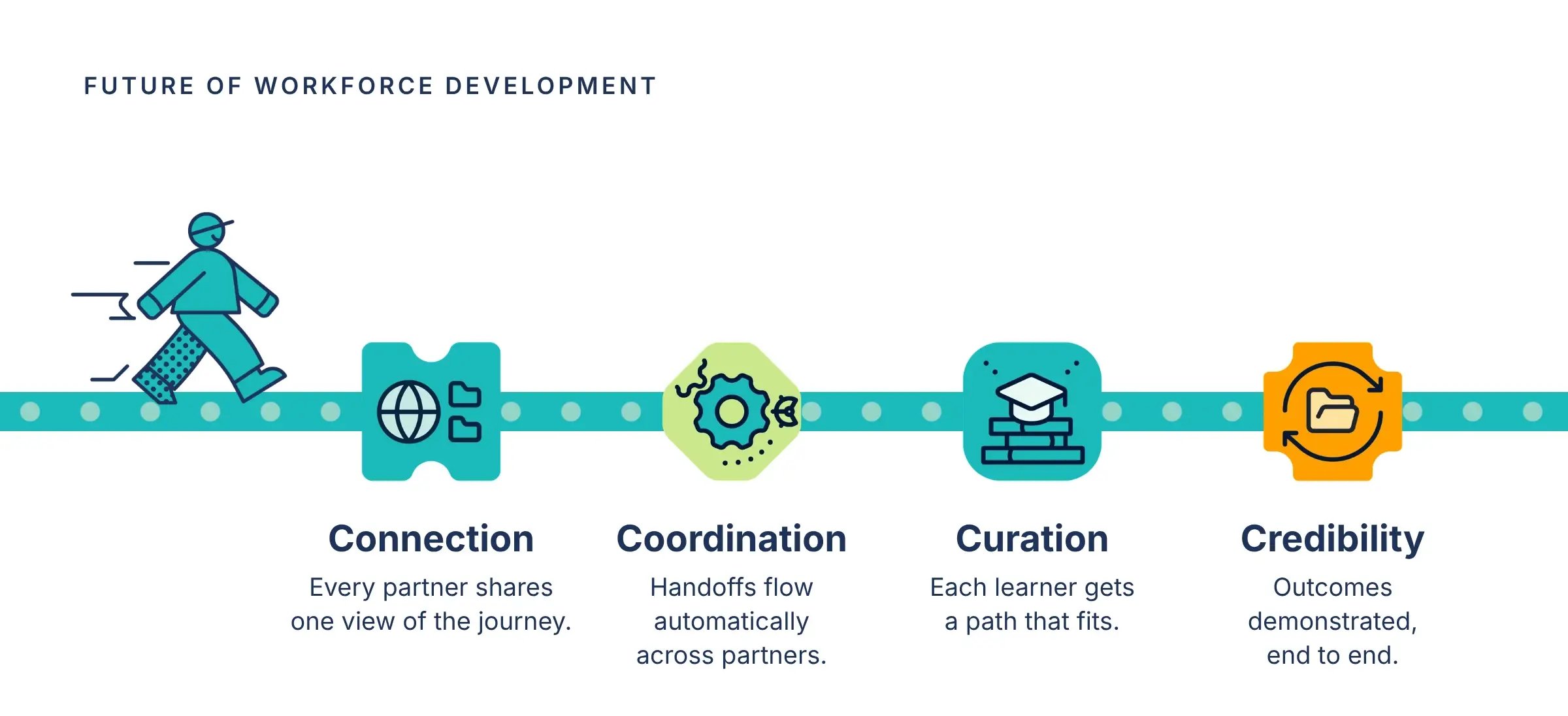
The opportunity is not to “rip and replace” and start over. We don’t have time for that. It is an asset- and community-based approach - to leverage what already works, using digital and data infrastructure to unify workforce systems and their data, enabling connection, coordination, and curation while creating the credibility to demonstrate outcomes at scale.
What Workforce Infrastructure Looks Like
This isn't a theoretical future state. It's already taking shape. But to function as true workforce infrastructure, the technology has to meet a higher bar than solving for individual programs or use cases.
To do that, workforce infrastructure needs several foundational capabilities:
Multi-sided, safe, and secure. Workforce systems must connect learners, employers, training providers, navigators, funders, and other partners while giving each the right level of access, visibility, and control. Connection at scale requires infrastructure designed from the start for secure data sharing and visibility across organizations and roles.
Enterprise-grade, but flexible by design. Infrastructure must support the full learner-to-employment journey while adapting to a wide range of use cases and initiatives. It must be configurable to support different programs, partners, and workflows, from registered apprenticeships and occupation-specific talent pipelines to sector-wide or community-wide workforce initiatives.
Built for scale. True infrastructure must support large populations, multiple programs each with different partners, and large volumes of data while remaining safe, secure, and reliable as the system grows. What works for one program must be capable of working across a sector, community, or broader workforce system.
AI-powered matching and personalization. Serving people at scale cannot mean relying on mass communication and generic matching. AI helps create personalized pathways that connect learners to the right training, work opportunities, and wraparound supports based on their individual needs. AI also helps identify where human support and intervention are needed most, allowing navigators and coaches to focus their time where it can help more learners progress to and through employment.
Data capture and analytics built around outcomes. Infrastructure must capture what happens across the journey, from participation and placement to retention and wage progression, and turn that information into actionable insight. That creates the credibility to demonstrate learner and employer outcomes, understand ROI, and continuously improve what is working.
Why STEAMe
STEAMe's workforce infrastructure leverages our deep technology expertise in serving ecosystems at scale.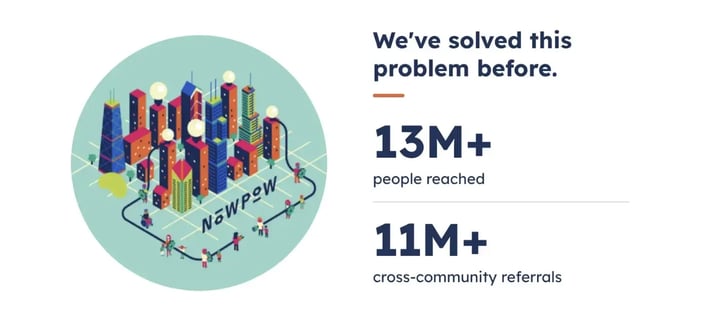 STEAMe's founding team created NowPow, digital and data infrastructure for social care that managed referrals across healthcare systems and health plans, patients, and community organizations. We took it to scale across entire communities, ultimately helping more than 13 million people and enabling more than 11 million cross-community referrals before being acquired by Unite Us in 2021. That experience taught us firsthand what it takes to build enterprise-grade infrastructure across complex, multi-sided systems where no single organization owns the entire journey.
That experience also shaped a core principle behind STEAMe: systems can operate as one without requiring every organization to operate the same way. The infrastructure has to be flexible and configurable to accommodate different programs, partners, and workflows, from light-touch initiatives to the highest-touch models, while creating enough consistency across them to deliver outcomes at scale.
Systems, Not Programs
The next era of workforce development requires a shift from a programs approach to a systems approach, building the connective tissue that connects strong programs and partners, aligns talent supply with employer demand, and creates sustainable and scalable talent pipelines.
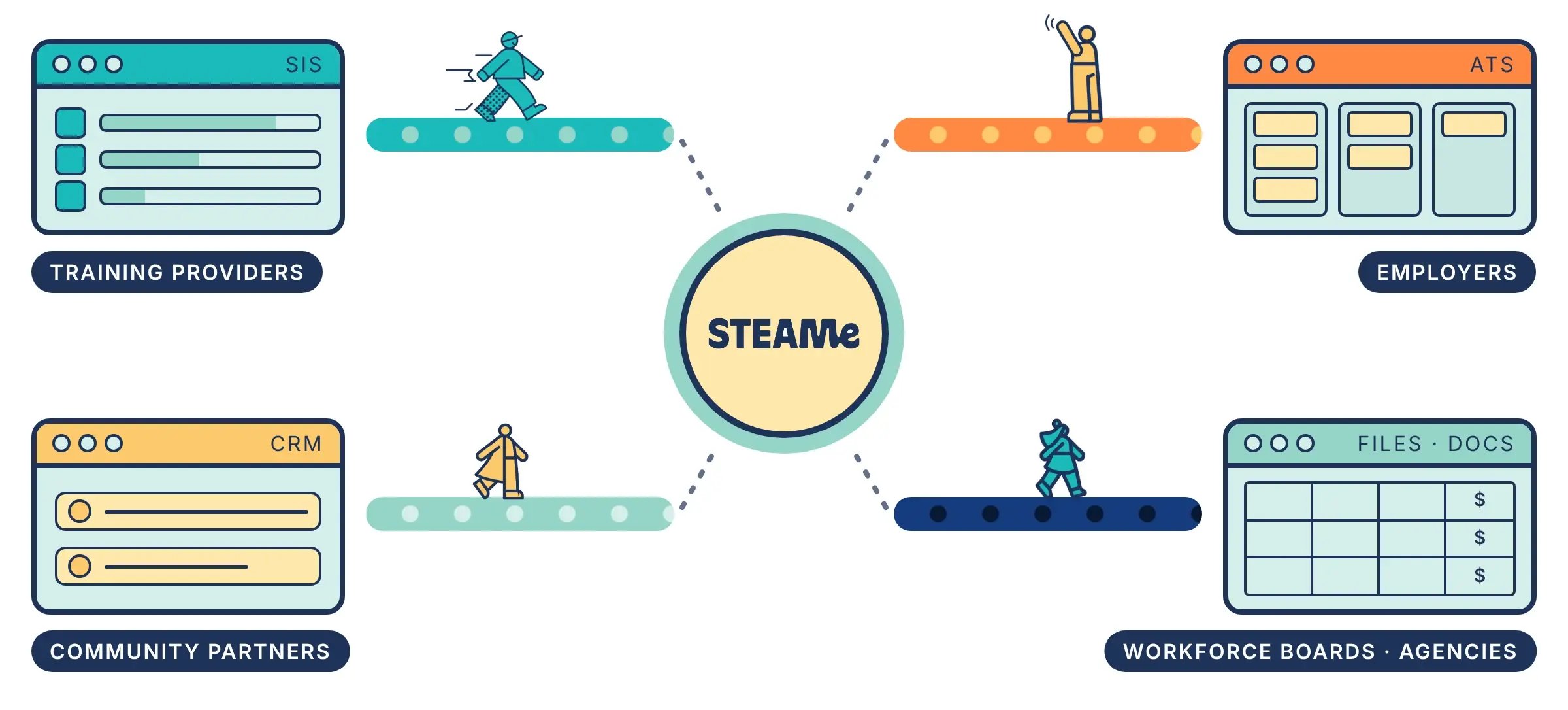
The question is no longer whether individual programs can succeed. It's whether we're willing to build the systems that make success possible at scale. Whether you’re leading one program or a whole community, book a demo to learn how STEAMe scales with you.