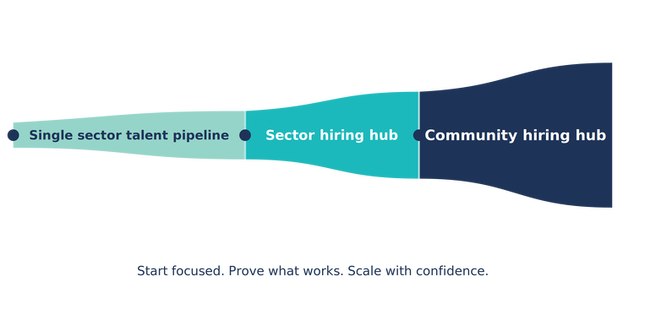
A single sector talent pipeline is often the first step toward building a connected workforce ecosystem. By focusing on one industry or one regional labor market, communities can launch workforce initiatives faster, prove what works, and create a foundation for long-term expansion. Through our work with workforce organizations, employers, and community partners, we've developed a practical perspective on what it takes to build a successful talent pipeline.
Key Takeaways
- Narrow beats broad. An effective talent pipeline focuses on one industry and one regional labor market.
- You don't need new systems to start. Low-lift adoption means connecting existing tools and partners, not replacing them.
- If you can't measure last-mile placement, you don't have a pipeline — you have a program. Outcome tracking has to be built in from day one, not bolted on later.
What Is a Single Sector or Workforce Talent Pipeline?
A single sector talent pipeline is a focused workforce initiative within one industry or regional labor market that brings employers, workforce organizations, educators, and community partners together to prepare and place qualified candidates into jobs.
At STEAMe, this is the first implementation model of our STEAMe Hiring Hub(™). It brings workforce partners together through one connected talent pipeline, making it easier to coordinate services, expand personalized job placement, and measure outcomes from training to employment. As needs grow, the model can scale into a larger sector-wide or community-wide Hiring Hub.
Rather than each organization working independently, employers, training providers, workforce leaders, and other partners collaborate through a shared Hiring Hub. The Hiring Hub provides the infrastructure to connect workflows, move qualified candidates from training to employment, and measure outcomes across the entire initiative.
You may also have heard the term Talent Pipeline Management® (TPM®), developed by the U.S. Chamber of Commerce Foundation. TPM® is a proven framework that helps employers and workforce partners align around shared talent needs. STEAMe's Hiring Hub(™) is not a replacement for TPM, it's the infrastructure that helps communities operationalize it.
When workforce organizations are connected through shared workflows, secure data, and measurable outcomes, a single talent pipeline could become the foundation for a stronger, more responsive workforce ecosystem that can grow alongside employer demand and community needs.
Why Talent Pipelines Break Down

Even the strongest sector partnerships can struggle when every organization operates from its own legacy systems or disparate technology stack. The result is a fragmented talent poolne that's difficult to scale.
Common challenges include:
- Referrals get lost: Learners are passed between partners through emails, spreadsheets, and phone calls, making it difficult to know where someone is along their career pathway.
- Employers lack visibility: Hiring managers can't see who's qualified, which candidates are job-ready, or where talent stands in the hiring process. Without a shared view of candidate progress, promising candidates are often overlooked.
- Learners don't complete the last mile: Completing training doesn't always lead to employment because no one owns last-mile placement from graduation to hire.
- Partners can't measure success: Each organization tracks data differently, making it difficult to understand job placement outcomes, wage progression, or broader economic impact.
- Scaling becomes harder than launching: Without shared infrastructure, every new partner adds complexity instead of capacity. As employer demand shifts, the entire initiative becomes slower to respond, making it harder to support a healthy talent supply chain.
Successful talent pipelines depend on more than strong programs. They require shared workforce infrastructure that connects partners, coordinates services, and measures outcomes from training to employment.
The Building Blocks of a Single Sector Talent Pipeline
Building a successful single sector talent pipeline doesn't require a massive overhaul. It starts with a handful of foundational decisions that make collaboration easier, outcomes clearer, and growth sustainable
1 - Identify a Strong Sector Champion
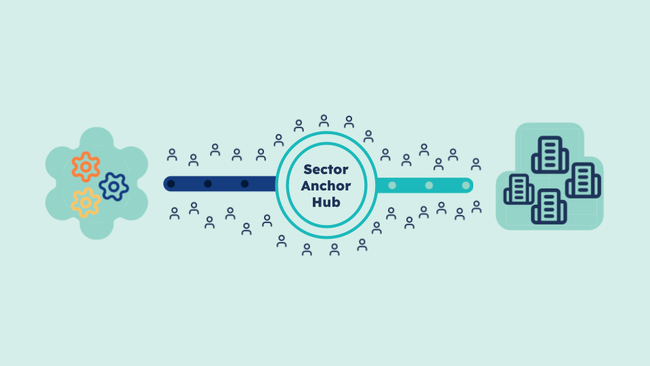
Every successful talent pipeline needs a convener or anchor organization. Their role is to align partners, coordinate workflows, manage outputs, and keep everyone focused on shared outcomes.
In many communities, that role is filled by a workforce board, community college, nonprofit, backbone organization, or other trusted entity with strong relationships across employers and training providers.
Tap an existing partner to step into the leadership role, bringing stakeholders together around a shared vision, common processes, and measurable outcomes.
The right leader doesn't have to do all the work, they create the conditions for partners to work better together.
2 - Start Small with a Single Sector Partnership
One of the biggest mistakes is trying to solve every workforce challenge at once. Start with a single sector partnership and one shared goal.
- Bring together a focused group of employers, training providers, and workforce partners committed to the same outcome.
- Prioritize employer demand first. Start with employers that have clear hiring needs and build the talent pipeline backward from those opportunities.
- Narrow your scope for easier launch - keeping your scope tight and focused will make it faster to align, and quicker to demonstrate results. Once it's producing a robust talent pipeline, expanding to additional employers or sectors becomes easier.
3 - Map the Career Pathway Before You Recruit
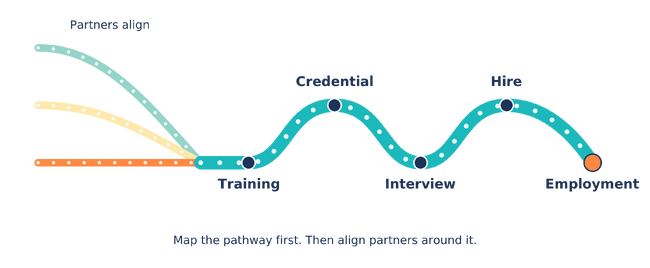
Many workforce initiatives get stuck because they recruit learners and employers before defining the learner journey.
- Map the entire career pathway.
- Define the required steps from training and credential completion to interviews, hiring, and employment.
- Align employers and workforce partners around that shared journey.
- Identify potential friction points early. Anticipate where learners are most likely to stall and build processes to keep them engaged.
It’s important to build for personalized placement, not one-size-fits-all. When pathways reflect the needs of both employers and the learners in your talent pool, more people successfully make the transition from training to employment.
4- Use the Systems You Already Have
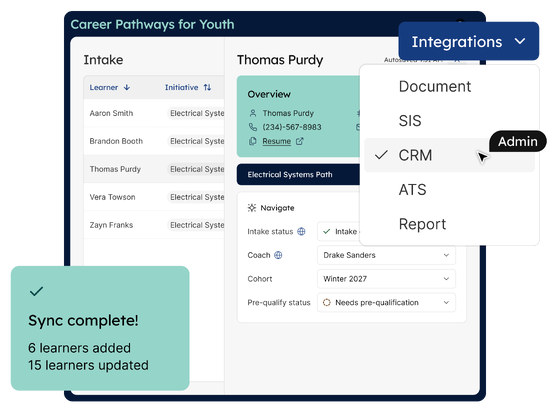
Reducing the burden on partners makes adoption easier and creates a stronger foundation for long-term participation and scale.
Look for interoperable workforce technology that connects to the systems you're already using instead of replacing them.
That way everyone can continue using their existing tools while securely sharing the workflows, data, and information needed to build a robust sector focused talent pipeline.
5- Build Last-Mile Placement Into the Design
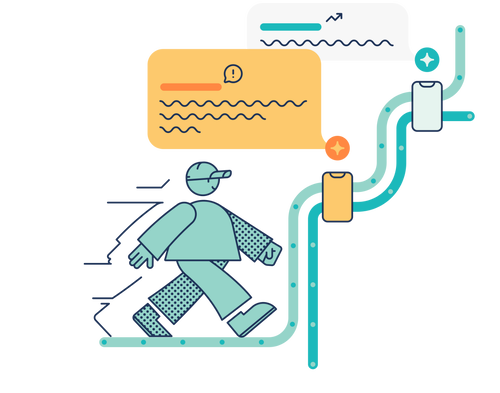
The biggest gap isn't training—it's last-mile placement. Too many workforce initiatives treat job placement as the finish line instead of designing for it from the beginning.
Build these elements into your pipeline from day one:
- Employer engagement throughout the training journey
- Shared referral workflows between partners
- Interview coordination and candidate matching
- Placement support that helps learners transition into employment
When the transition from training to employment is intentional, you design for employment, not enrollment.
6- Track Outcomes From Day One

Don't wait to define success. Establish your goals before the pipeline launches so every partner is working toward the same outcomes.
- Measure more than enrollment and completions.
- Track job placement outcomes, time to placement, employer engagement, and retention to understand what's working and where improvements are needed.
- Report out on data, insights, and improvement areas to your workforce partners. So everyone has a stake in the outcomes.
Shared outcome tracking gives workforce partners the visibility to demonstrate impact, strengthen employer confidence, and continuously improve the pipeline as workforce needs evolve.
For many communities, a Single Sector Talent Pipeline isn't the end goal—it's the beginning. It's often the first Hiring Hub a community launches, creating the foundation for broader employer engagement, additional sectors, and eventually a connected workforce ecosystem. See how a single sector pipeline fits into a full Hiring Hub.
Frequently Asked Questions about Single Sector Talent Pipelines
How Many Partners Does It Take?
You don't need dozens of organizations to build a successful talent pipeline. In fact, starting small with one shared workforce goal that aligns everyone around success is often the fastest path to long-term success.
A successful pipeline can begin with:
- One employer or employer group committed to hiring.
- One training provider preparing talent for those opportunities.
- One workforce intermediary to coordinate partners and track outcomes.
How Long Does It Take to Launch?
Communities can often launch their first Hiring Hub or a single sector talent pipeline in weeks, with the right workforce infrastructure and current systems partners already use.
Resist the urge to recruit every potential partner. Prove the model first, then expand.
How Do You Measure ROI on a Single Workforce Initiative?
Define the workforce initiative outcomes that matter most to your community, employers, and funders. Focus on metrics that demonstrate real impact, such as:
- Job placement outcomes
- Time from training completion to employment
- 90- and 180-day employment retention
- Employer engagement and hiring activity
- Wage progression and career advancement over time
What's the Difference Between a Talent Pipeline and a Hiring Hub?
A talent pipeline is the coordinated process that prepares and moves qualified candidates into employment within a specific industry or region.
A Hiring Hub provides the infrastructure that supports that process. It connects employers, workforce organizations, educators, and community partners through shared workflows, secure data sharing, referral management, and outcome tracking.
Can a Single Sector Talent Pipeline Scale to Multiple Industries?
Yes. At STEAMe, communities often begin with a single-sector talent pipeline as their first implementation of the STEAMe Hiring Hub(™), establishing partner relationships, and demonstrating measurable outcomes.
Once governance, workflows, and reporting are in place, additional industries can be added without starting from scratch.
This phased approach reduces implementation risk while creating the foundation for a connected workforce ecosystem that can respond to changing employer demand across multiple sectors.